Showing posts with label Civil War. Show all posts

Sunday, February 6, 2022

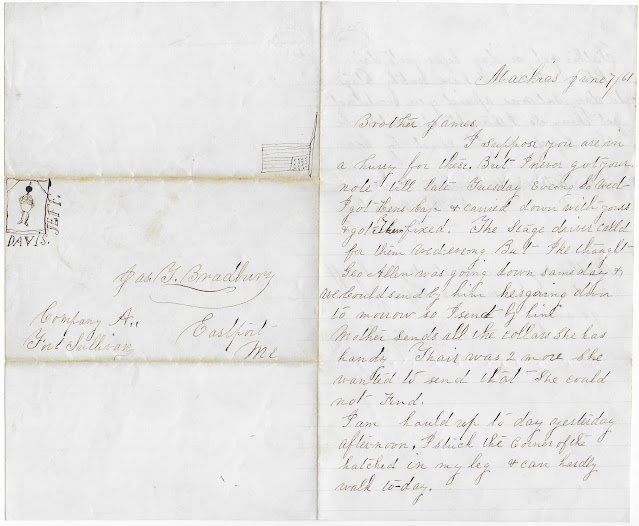
1861 Letter from William W. Bradbury, "Willie", in Machias, Maine, to his brother James True Bradbury, serving in Company A at Fort Sullivan, Maine; Effigy of Jefferson Davis


Reprinted, with permission, from the Heirlooms Reunited blog

June 7, 1861 letter from William Wyer Bradbury (1843-1901), "Willie", in Machias, Maine, to his brother James True Bradbury (1840-1863), serving in Company A at Fort Sullivan in Eastport, Maine.

The letter features a sketch by Willie of Jefferson Davis hanging in effigy. The letter was written after the attack of April 1861 on Fort Sumter in South Carolina, and contains the implication that James would be leaving Fort Sullivan, presumably for war. 

Sadly, James did not survive the war; he died in the Second Battle of Rappahannock Station in Virginia, in November of 1863.


Mentioned in the letter:

If you have information to share on the Bradbury and Webber families or information on a likely prospect for George Allen, please leave a comment for the benefit of fellow researchers.

Despite the map below, bear in mind that travel between Machias and Eastport was just as likely to have occurred by sea.

Friday, December 24, 2021

1861 Letter from Lewis W. Campbell, Student at Washington Academy in East Machias, Maine, to Friend James in Company C, 6th Maine Infantry

Reprinted, with permission, from the Heirlooms Reunited blog.

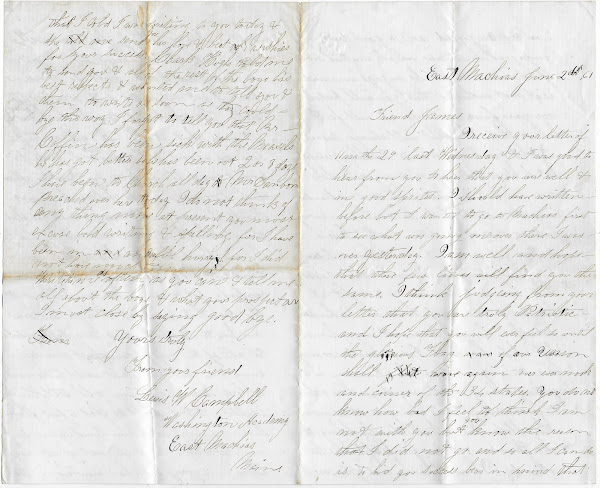
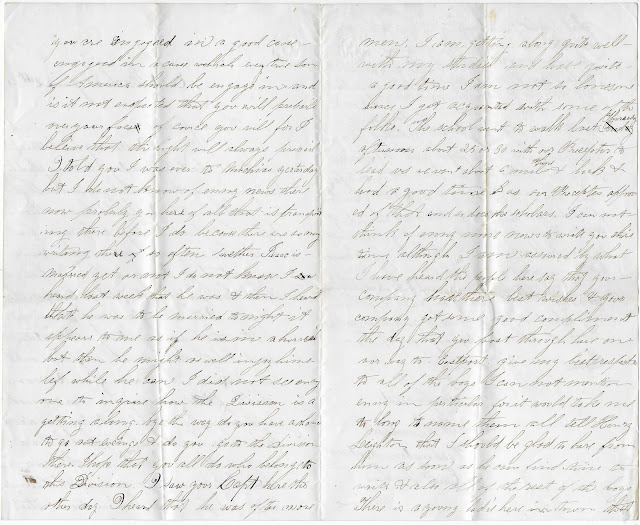
June 2, 1861 letter from Lewis W. Campbell (1841-1926), a student at Washington Academy in East Machias, Maine, to his friend James, serving with the 6th Maine Infantry in the Civil War.  

Like untold other Mainers, Lewis would move to Minneapolis and become an influential citizen there.

The letter mentions:
  • James, the recipient of the letter - there were several men named James in the area who enlisted in Company C, 6th Maine Infantry
  • Machias, the next town over, where I believe Lewis W. Campbell's family lived
  • Isaac - is he married yet or not - could not find a record; perhaps Isaac is a middle name or he married later on
  • the Captain of the 6th, looking for more men
  • Washington Academy in East Machias, Maine
  • Eastport, Maine - perhaps the recruits shipped out of there
  • Henry Leighton - also presumably serving with the 6th - perhaps Henry Hudson Leighton (1840-1916), who enlisted into Company C, 6th Maine Infantry
  • a young lady who sends her regards
  • Clark Hughs - perhaps Clark Perry Hughes (1839-1862), who enlisted on 15 July 1861 into Company C, 6th Maine Infantry. He was discharged for disease in September of 1861 and died in January 1862. 
  • Mr. Coffin, sick with the measles
  • Mr. Sanborn preached - perhaps New Hampshire native John L. Sanborn (1813-1895), Baptist clergyman, who was living in East Machias, Maine, at the time of the enumeration of the 1860 Federal Census.
A transcription appears at the end of this post.


Lewis himself would enlist, on 11 August 1862, into Company B, 11th Regiment, Infantry, as a private and was eventually promoted to sergeant. He was wounded in 1864 at Deep Bottom Run in Virginia, but he survived the war, rising to the rank of 2nd Lieutenant at Appomatox.

See a CDV of Lewis W. Campbell, in uniform, taken about 1864 - on the Maine Memory Network.  Read a letter Campbell wrote in 1864.

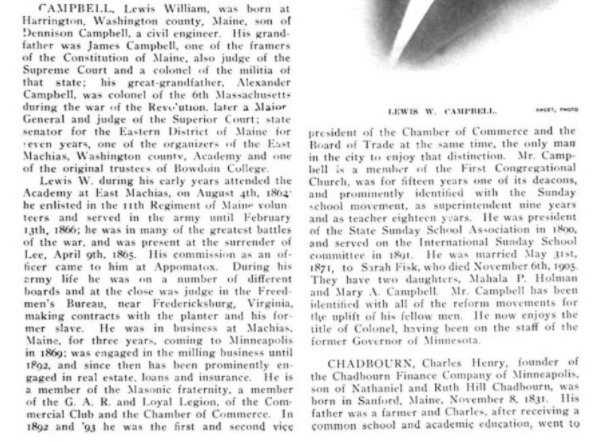
Lewis W. Campbell moved to Minneapolis and became a miller and a citizen of note, such that his biography is included on page 267 in A Half Century of Minneapolis, published by Horace Bushnell Hudson in 1908.

From this biography, which includes an engraving of Campbell, we learn that he was born in Harrington, Maine, the son of Dennison Campbell. Lewis' grandfather was a signer to the Constitution of Maine, and his great grandfather a colonel in the 6th Massachusetts during the American Revolution.  Lewis' mother was (Martha Wakefield) Campbell, according to his Minnesota death record.


Lewis married New Hampshire native Sarah G. Fisk in Minnesota in 1871. They had at least two children, both daughters.

Transcription

East Machias, June 2d, 61
Friend James
I receive your letter of May the 29 last Wednesday & I was glad to hear from you to hear that you were well & in good spirites. I should have written before but I wanted to go to Machias first to see what was going on over there. I was over yesterday. I am well and hope that these few lines will find you the same. I think judging from your letter that you are truly Patriotic and I hope that you will ever feel so until the glorious Flag of our Union shall wave again over ever nook and corner of the 34 states. You do not know how bad I feel to think I am not with you but you know the reason that I did not go and so all I can do is to bid you success. Bear in mind that you are engaged in a good cause - engaged in a cause which every true Son of America should be engage in and is it not expected that you will prevail over your foes. Of course you will for I believe that the right will always prevail. I told you I was over to Machias yesterday but I do not know of any news there. Now probably you here of all that is transpiring there before I do because there are so many writing there so often. Whether Isaac is married yet or not I do not know. I heard last week that he was & then I heard that he was to be married tonight. It appears to me as if he is in a ____ but then he might as well enjoy himself while he can. I did not see anyone to inquire how the Division is a getting along. Bye the way do you have a chance to go out evenings & do you go to the Division there. I hope that you all do who belong to this Division. I saw your Capt. here the other day. I heard that he was after more men. I am getting along quite well with my studies and have quite a good time. I am not so lonesome since I got acquainted with some of the folks. The School went to walk last Thursday afternoon about 25 or so with our Preceptor to lead us. We we went about 6 miles & back & had a good time as our Precepter approved of that and so does the scholars. I can not think of any more news to write you this time although I am assured by what I have heard the people here say that your company ____ there. Best wishes & your company got some good compliment the day that you past through here on our way to Eastport.  Give my best respects to all of the boys. I can not mention any in particular for it would take me to long to name them all. Tell Henry Leighton that I should be glad to here from him as soon as he can find time to write. & also all of the rest of the boys. There is a young ladie here in town that that I told I was writing to you today & she sends you her love & best wishes for your success. Chark Hughs told me to send you & all the rest of the boys his best respects & wanted me to tell you & them to write as soon as they could. By the way, I forgot to tell you that Mr. Coffin has been sick with the measels. He has got better so he has been out 2 or 3 days. I have been to Church all day. Mr. Sanborn preached over here today. I do not think of any thing more at present. You must excuse bad writing & spelling for I have been in an awful hurry for I did not have much time.
Write to me as often as you can & tell me all about the boys & what your prospects are. I must close by saying good bye.
Yours truly
From your friend
Lewis W. Campbell
Washington Academy
East Machias
Maine

If you have corrections and/or information to share on any of the people mentioned, please leave a comment for the benefit of other researchers.

Wednesday, December 15, 2021

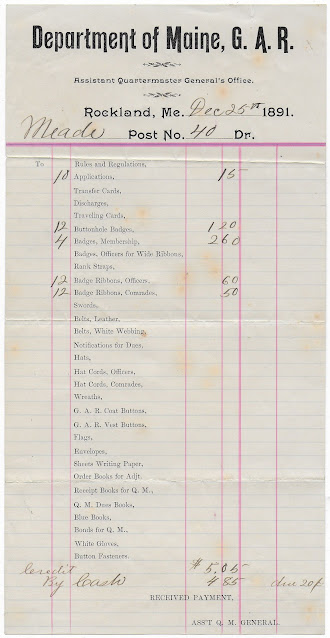
1891 Invoice from the Department of Maine GAR at Rockland, Maine, to Meade Post #40 at Eastport, Maine


Reprinted, with permission, from the Heirlooms Reunited blog

December 25, 1891 invoice from the Department of Maine, Grand Army of the Republic, at Rockland, Maine, to Meade Post #40 at Eastport, Maine, which was requesting:

  • applications
  • buttonhole badges
  • membership badges
  • badge ribbons for officers
  • badge ribbons for comrades

 Sadly, the document does not list any names of GAR members.

The second floor of the GAR Meade Post 40 hall in Eastport, currently undergoing restoration, is decorated with many murals, at least some of which were reportedly painted by a Harrington.  It's said that Joshua Chamberlain, on a tour of GAR posts in Maine, was considerably impressed.


 If you have information to share on Meade Post 40 of the GAR at Eastport, Maine, Maine, please leave a comment for the benefit of other researchers.

Sunday, September 26, 2021

Newspaper Clipping about Theodore Lincoln III of Dennysville, Maine, & the 6th Maine in the Civil War

Reprinted, with permission, from the Heirlooms Reunited blog.

Newspaper clipping about Major Theodore Lincoln, Jr., a Dennysville, Maine, native, and officer in the Sixth Maine 

Note: Rather than Theodore Lincoln, Jr., I believe he was that man's son Theodore Lincoln III (1830-1865) as this Maine veterans cemetery record indicatesMany military records refer to him as a Jr.

Found in a journal of underlying handwriting pasted over with many clippings, presumably by someone sympathetic to the Union and with abolitionist leanings.

A transcription appears at the end of this post.

Theodore Lincoln III (1830-1865) was the son of Theodore Lincoln, Jr., (1800-1867) and Elizabeth Cushing Lincoln (1800-1877). Theodore III was the great grandson, as the article notes, of Benjamin Lincoln (1733-1810) was the celebrated Revolutionary War General to whom Cornwallis' second offered his surrender at Yorktown.

If you have information to share on any of the people mentioned above, please leave a comment for the benefit of other researchers.  

Perhaps a reader will know if Theodore Lincoln III came home from the War in 1864 with lingering illness or injury, which contributed to his death in 1865.

Transcription:

SIXTH MAINE
This regiment, with 90 men, under command of Major Theodore Lincoln, Jr., also came in the Weybosset [a steam ship]. Major Lincoln is a great grandson of Major General Benjamin Lincoln of the revolution, to whom Lord Cornwallis surrendered. Major Lincoln has been with the regiment ever since its formation, entering it as Orderly Sergeant. He has passed through many severe battles, beginning at Yorktown, and ending with one of the last skirmishes before Petersburg. Of the original regiment of one thousand there are only about seventy left, and of these Major Lincoln is one. He has passed unwounded through his numerous battle, though repeatedly greatly exposed. Few of our young officers have rendered more effectual service, or shown a cooler and more determined bravery in action. He has the confidence of his men, and we trust there are higher military honors in reserve for him.

Saturday, September 25, 2021

Two Period Newspaper Articles about the Confederates Raids in Eastern Maine

Two period newspaper clippings about the raids in Eastern Maine, carried out or proposed, by Confederates massing in Saint John, New Brunswick, during the Civil War.

Reprinted, with permission, from the Heirlooms Reunited blog.

The clippings mention
  • Saint John, New Brunswick
  • Calais, Maine
  • Eastport, Maine
  • Belfast, Maine (to whose leaders a warning was sent from Eastport)

The clippings are contained in a notebook, the original handwriting in which is covered over by many newspaper clippings that appear to have been pasted there by someone with Union and abolitionist sentiments.

Transcription of the clipping at top:

A LITTLE RAID IN MAINE - ATTEMPT TO ROB THE CALAIS BANK. Calais, Me., 18th
At midday today there was an attempt to rob the Calais Bank by a small party of rebel raiders, who came from St. John, N.B. Three of them were arrested. The leader of the gang is Capt. Collins of the 15th Mississippi regiment. They say some thirty associates promised to meet them here, but failed. The vigilance of the State Guard prevented the consummation of this bold scheme of pillage. The three men have been committed. The citizens are arming in expectation of an attack tonight.

The second clipping:


Transcription:

EXCITEMENT ON THE BORDER OF EASTERN MAINE
Rebel Raid Apprehended

The St. Croix Herald, published at Calais, Me., represents that a general excitement pervades the towns on the eastern boundary of Maine, growing out of an apprehended foray by rebel refugees in the British Provinces. The Herald of 23d says:
"The towns on this border have been alive with excitement during the past few days and nights owing to well authenticated reports that a raid was in contemplation by rebel agents and "roughs" who had their headquarters at St. John. We were reliably informed when in St. John a few days ago that the programme of rebel operations consisted not only in the taking of the Chesapeake but also the steamer New England, and then making a raid upon the towns on the border, robbing the banks and committing general destruction by fire, robbery, etc. The failure to take the New England rather strengthened the impression that the raid on the borders would be attempted, and accordingly on Thursday night the people here and at Eastport organized for home defense.
There was any number of citizens ready to volunteer, and the every effort was made to give the invaders a warm reception. A company of about seventy men was raised for the emergency, consisting of nine months' men and State Guards, under the command of Capt. Flint. Their rendezvous was at the Armory. Squads of the men were detailed for picket duty at the several bridges and other exposed stations leading from New Brunswick, through which channel the rebs intended to find their way into our city. At intervals during the night of Thursday, as reports came in to the headquarters from the various outposts, intense excitement was manifested, and strong hopes were entertained that is the invaders were really coming they would come then and there.
The night was stormy and the guards, notwithstanding they were unaccustomed to the service, entered into the work with much zeal and enthusiasm. Between three and four in the morning a fire broke out and destroyed an old building somewhere in the rear of the town of St. Stephen. It was thought by some that it was intended as a decoy, but it didn't take as the guards had orders not to leave the city. It was supposed that some suspicious persons, the advanced guard of the enemy's forces, were prowling about the city, and the Provost Marshal was directed to make a search at the Exchange where the suspected men were stopping, but there was nothing discovered that would implicate the parties. Toward morning the guards descried some men lurking about the post office, but no arrests were made.
Thus ended the first night of the watch for the invaders. Their non-appearance was regretted, as many of our boys were 'splilin' [presumably 'spoilin'] for a right, and unless the raiders had come in overpowering numbers, but few of them would have lived to tall the tale of the adventure. Men have since been detailed nightly for the service, and the tread of armed men through our streets at the midnight hour has recently become one of the features of life on the border. At Eastport, the citizens are also wide awake, and a large force patrol the streets and guard the town nightly. There can be no doubt, from information received on the subject from various sources, that such a rain as we have been preparing for has been and is in actual contemplation. It will not do to slumber as we are yet by no means secure from danger."

The Provost Marshal of Belfast has received a letter from Eastport, which says:
"Last night almost every man and boy in Eastport went armed, and a guard of sixty men was kept in Frontier Bank all night. It seems a large party of roughs left St. John for some place, and a remark made by them was overheard before they left, that they were going to rob a bank in the United States, within sixty miles of St. John."

The citizens of Eastport telegraphed to Augusta for seventy-five rifles or muskets."

At this time, the Army still maintained Fort Sullivan in Eastport on Moose Island, although it was much reduced in readiness.

If you have information to share, please leave a comment.