Business card of antique dealer James N. Jollotta (1912-1993), "Jim", of Eastport, Maine, with an Abraham Lincoln campaign button pinned to it.
Jim made a point of making friends of everyone he met, from figures in World War II, to politicians and their families, to screen stars, to Eastporters made good and to any interesting man or woman he encountered. Until his death in 1993, he spent every Christmas with Caroll Edwin Spinney (1933-2109), originator and persona of "Big Bird" and "Oscar the Grouch", himself with Eastport connections.
The pin itself is not in the best condition but when I saw it on eBay in 2013, I had to have it for its connection to Jim, who was a friend of the family.
The reverse has a message written in Jim's hand, on October 23, 1963, noting that he was presenting the pin to Rev. Otto L. Palmer (1927-2021). Jim noted that the pin had originally been presented to him by the late Mr. Joannson.
Perhaps Rev. Palmer, a native of Aroostook County, Maine, pastored at Eastport at some point, or he and Jim met each other at a gathering of some kind.
If you have information on James N. Jollotta (1912-1993), "Jim"; or Rev. Otto L. Palmer (1927-2021); or an identity for Mr. Joannson, please leave a comment for the benefit of other researchers.

Possibly James Colin MacNichol (1886-1960), if he went by "Colin", at least when he was younger. This man was born in Eastport, Maine, the son of Avery Alexander MacNichol and Margaret (O'Brien) MacNichol. This Colin would move to New York and would marry Nancy Nicholls.
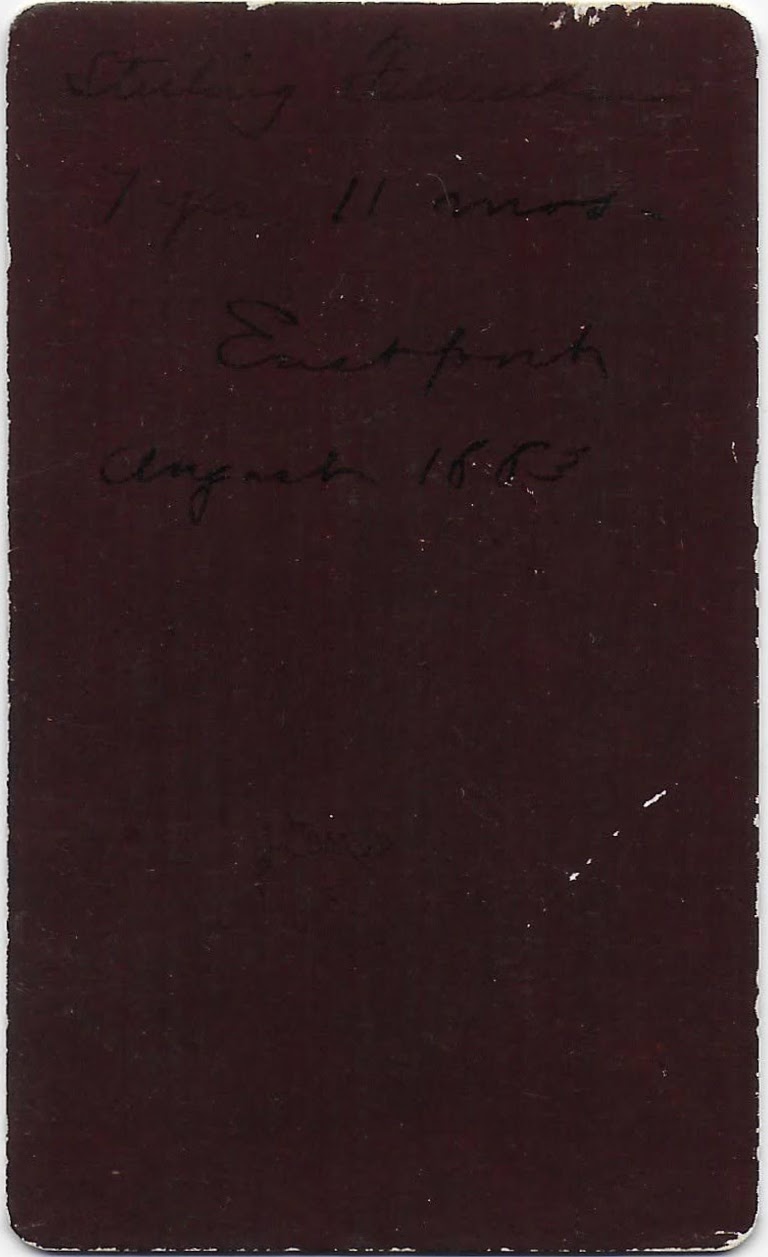
It's likely that Sterling was Sterling Fessenden (1875-1943), son of Nicholas Fessenden (1847-1927) and Laura Emily (Stirling or Sterling) Fessenden (1852-1935) [although her birth year looks to be 1851 in the photograph of her stone]. An interesting article from the Seacoast Online of New Hampshire about Chinese families in Exeter, New Hampshire, which contains mention of the family of John Moor(e) Thistle (abt January 1854-1910) of Eastport, Maine, who married a Chinese woman, Mary Ah Say or Ashay (1864-1903) , in Japan.
According to the article, John and his bride moved to Shanghai, China, where they had four children, and later moved to the United States, presumably the area of Portsmouth, New Hampshire, where another two children were born, at least one in Portsmouth in 1892.
At the time of enumeration of the 1900 US Census, John and family were living in Exeter, New Hampshire. John, the son of Irish immigrant James Thistle and Louise (Roix) Thistle, died in 1910 in Exeter.
Read the article here:
June 10, 1814 letter from Lieutenant E. Manning of the 40th Infantry, stationed at Fort Sullivan in Eastport, Maine, to Lieutenant Andrew Lewis, 40th Infantry Commanding, at Castine, Maine.Tilly Laskey, curator at Maine Historical Society, has sent along a link to the sales offering of a wonderful family record sampler wrought in 1846 by Sarah Ann Cheeney (1835-1895), then in Eastport, Maine.
https://www.antiquesamplers.com/samplers/cheeney,-sarah-a.htm
Sarah was born in Pembroke, Maine, on April 27, 1835 to George Cheeney and his wife Mary A., natives of Derry, New Hampshire, and Salem, Massachusetts, respectively. George and Mary had married in Dennysville, Maine, on July 28, 1834.
Children listed on the sampler:
Reprinted, with permission, from the Heirlooms Reunited blog
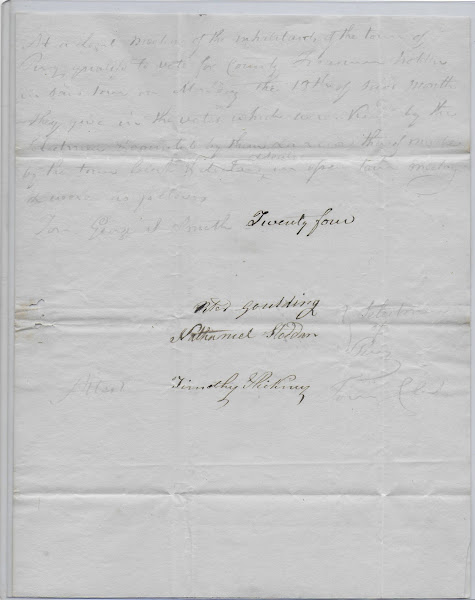
1831 report from an ecclesiastical council held at Robbinston, Maine, to determine whether or not to dismiss Rev. Calvin White from his church there.
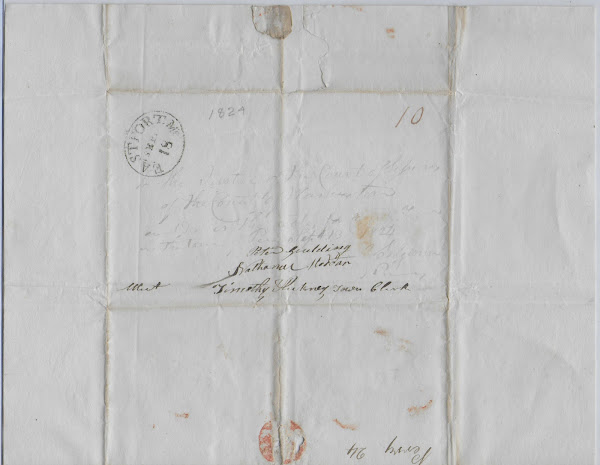
The document was addressed to Reg. John Balkam, Postmaster, Robbinston, Maine.
Mentions:
Reprinted, with permission, from the Heirlooms Reunited blog
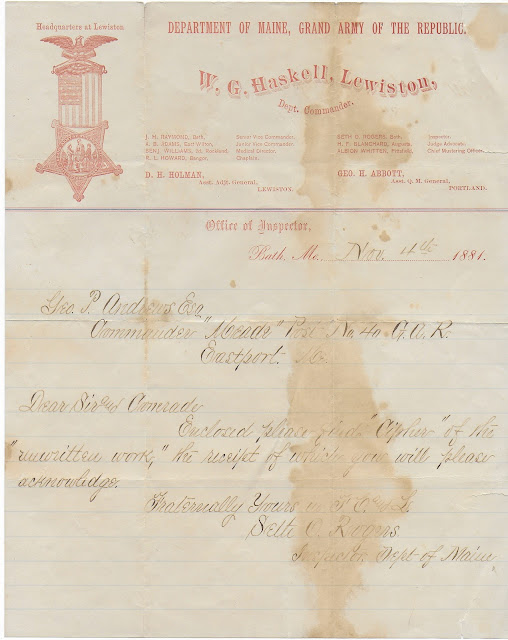
November 4, 1881 letter from Seth O. Rogers, Inspector, Department of Maine, Grand Army of the Republic, at Bath, Maine, to George P. Andrews, Esq., Commander of "Meade" Post 40, G.A.R., at Eastport, Maine.
Nothing on reverse.
Transcription:If you have information on either man or on Meade Post 40, G.A.R., Eastport, Maine, please leave a comment for the benefit of other researchers.
The map below gives land routes, but missives such as this might well have been carried by sea.