Wednesday, January 19, 2022

1840 Letter from Mary Lydia Richardson (1823-1907) studying in Portland, Maine, to her father Dr. Erastus Richardson (1794-1855) in Eastport, Maine

Reprinted, with permission, from the Heirlooms Reunited blog.

January 6, 1840 letter from Mary Lydia Richardson (1823-1907), studying or seeking a school in Portland, Maine, to her father Dr. Erastus Richardson (1794-1855) in Eastport, Maine.

Another post features a letter with mention of Dr. Erastus Richardson:

A transcription of Mary's letter appears at the end of this post.  If you have information to share on any of the people mentioned in the letter, please leave a comment for the benefit of other researchers.
Mentioned in the letter: - hopefully readers can fill in the blanks

Tuesday, January 18, 2022

1835 Letter from Aaron Hayden in Eastport, Maine, to Rev. Wakefield Gale in Boston, Massachusetts

Reprinted, with permission, from the Heirlooms Reunited blog

October 26, 1835 letter from Aaron Hayden at Eastport, Maine, to Rev. Wakefield Gale (1797-1881) in Boston, Massachusetts.

See other posts

The letter featured in this post was sent to No. 7, Montgomery Place, in care of Deacon Daniel Safford (1782-1856), widower of Abigail Jane Bigelow (1804-1830), sister of Rev. Gale's wife Mary Louisa (Bigelow) Gale (1806-1861).

Mentioned in the letter:


If you have information on any of the people mentioned, please leave a comment for the benefit of other researchers.


1828 Letter from Rev. Wakefield Gale (1797-1881) at Eastport, Maine, to his brother Joseph Worcester Gale (1809-1889) in Boston, Massachusetts

Reprinted, with permission, from the Heirlooms Reunited blog

December 17, 1828 letter from Rev. Wakefield Gale (1797-1881), a Congregational minister in Eastport, Maine, from 1825-1835, to his brother Joseph Worcester Gale (1809-1889), then in Boston, Massachusetts.

See other posts:

The brothers were Pembroke, New Hampshire, natives, the sons of Deacon Joseph Gale (1768-1851) and Susannah (Frye) Gale (abt 1776-1859)

A transcription of the letter appears at the end of this post.

Rev. Gale was the center of a furious controversy in Eastport in the late 1820s, as noted in the booklet Correspondence Between the First Congregational Society in Eastport and Rev. Gale, but he apparently rode it out until leaving in 1835.

More of Rev. Gale's correspondence is held in the Wakefield Gale Family Papers collection at Dickinson College in Carlisle, Pennsylvania.

Mentioned in the letter:

If you have information to share on any of the people mentioned in this letter, please leave a comment for the benefit of other researchers.

Transcription:

Eastport, December 17th 1828

My Dear Brother

The object of this hasty letter is to confess my fault in not writing you before & to inform you that we had a very quick and pleasant passage to this place after parting with you in Boston Harbor; that our articles of furniture all arrived safe; that Mary& little Jona. Edwards are quite well pleased with this place; that I am quite happy in having a little family of my own; that we live almost wholly by ourselves except taking our meals with Captain Rogers Family; & that the general interests of the little church and Society to which I am preaching are prosperous. We are not yet in the New Meeting House, but hope to be in a few weeks. Seriousness seems to be increasing in the congregation – 12 have attended an inquiry meeting at my study of late. Two are to be added to the church next sabbath. Some efforts are making to promote the cause of temperance here. We are having united meetings, that is, meetings of the several religious societies, in relation to this object. All the clergyman, four in number, are to preach on the subject twice a piece. We received a letter from Brother and Sister Ransom four or five weeks ago. They had arrived safely at Marietta tho their journey was rather longer than they expected. They experienced on their way a remarkable preservation. They with four other passengers were precipitated down a precipice 20 feet, and tho the stage was shivered to pieces, they were uninjured. Susan was pleased with the country, & with her new friends there. She did not regret leaving home - Her object is indeed good and great. I hope she will be faithful as long as she lives - & die in peace with her work done, & well done. We are expecting to hear from home soon. Mrs. G has written them a good long letter. They must be, I think, quite lonesome. But the Lord, I trust, is their ____. He will be with them & comfort them. I hope you will write them as often as convenient. Mother thinks a great deal about all her children. A letter often will be very gratifying. Do you intend going home by & by? How are you prospered in your business? With whom do you work? Where do you board? How do you prosper in religious things? Whose meetings do you attend on the Sabbath? Had you not better make Dr. Edwards meeting yours? Are you careful to maintain secret prayer? O my brother, do not neglect the soul! I hope you improve your leisure hours in useful reading, rather than in gazing at the vain objects of a large and enticing City. Dr. Franklin says, “Time is money”. The habit you now form will go along with you this life it is probable. Mind how you begin in every thing. You are greatly exposed in many ways. But your chief danger at present will be neglect the ___ & remiss ways in the duties of religion. Remember that you are young and inexperienced - & obey Our Saviors direction, to watch & pray but you enter into temptation. A young man of this place has called on me today, who is in trouble, & whose history himself interested me much. He is a school teacher – has studied some with a view of being a physician. He is poor, came here last Spring to get a school, with a view to aid himself in getting his profession. He is 23 years old - He joined the church in Bloomfield, Somerset Co. in this state when only 13 years old. His father died when this son was 12 years old - his mother when he was 15. He had lived like a Christian, till he came here. When he came to this place he concealed the fact ____ [tear in page] was a professor of religion - the youth and his first ____ society were all thoughtless - he engaged in a school but did not pray in it. He did not come to our communions - and no one knew till recently that he was a member of the Church of Christ. He has been round to a sense of his condition. Regrets the course he has taken, mourns... He has been ashamed of Christ - intends to confess his sin to the church before next Sabbath - & on the sabbath return to his duty and privilege in celebrating the love of Christ. He takes an active part now in our Saturday night prayer Meetings. If you have opportunity to take a part in such meetings or in family worship, I hope you will do it. It will be an advantage.Your employment is Honorable. I hope you will be contented with it & strive to excel as a mechanic, especially as a Christian and citizen. I want you to be a reading man and to form the habit and cultivate the taste for reading. Thus you will gradually and almost insensibly improve. 


Abby Jane Bigelow, sister of Mrs. G is expecting to be married next Wednesday evening at Dr. Edwards to Dea. Safford. You probably know Dea. Safford if you attend meetings at Salem Street Church.  Mary unites with me in love to you. Let us be remembered aff. to br. John when you see him or write to him also to Pembroke friends.

Monday, January 17, 2022

c1925-1929 Christmas Card of Maine Governor Ralph Owen Brewster, featuring the 1839 W. H. Bartlett engraving of "Eastport and Passamaquoddy"

Reprinted, with permission, from the Heirlooms Reunited blog

Holiday greetings, circa 1925-1929, from Maine Governor Ralph Owen Brewster (1888-1961) and wife (Dorothy (Foss) Brewster (1889-1971), featuring the 1839 W. H. Bartlett engraving of Eastport and Passamaquoddy Bay - From Lubec.

The Brewsters lived at 37 Zions Hill in Dexter, Maine.
If you have information to share on Gov. Ralph Owen Brewster, please leave a comment for the benefit of other researchers.

Sunday, January 16, 2022

1853 Letter from William, Traveling to Eastport, Maine, to Wife Mary in Boston, Massachusetts, area; Searching for "Family" of Caretakers

Reprinted, with permission, from the Heirlooms Reunited blog.

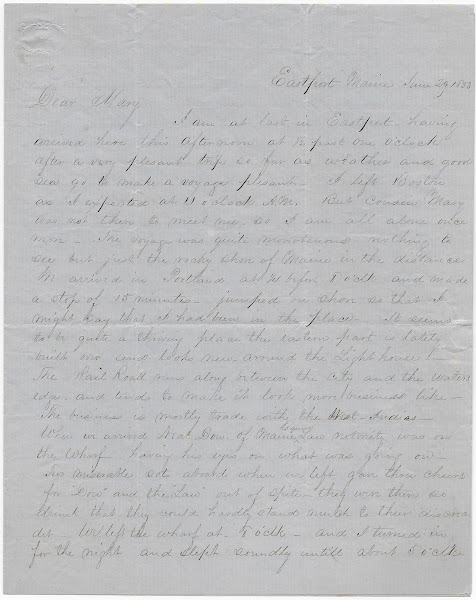
Letter dated June 29, 1853 from William, visiting at Eastport, Maine, to his wife Mary, with daughter Ella, back home, presumably in the Boston, Massachusetts, area.  

William, who is on a mission to procure a "family" to help his household at home, is not impressed by the rocky aspects of the Maine coast.  If he can't find a "family", he will have to consider some single girls.

Transcription at the end of this post - any corrections gratefully received, as well as theories as to William's identity.

Another guest at the Mabee Hotel where William is staying has this advice: go to "Prince Edwards Island", as there are an abundance of such families who have nothing to do - and are of Scotch descent. 

People and places mentioned in the letter:
  • Mary - William's wife in the Boston, Massachusetts, area; daughter Ella
  • Cousin Mary, presumably also in the Boston area
  • Portland, Maine - 15 minute stop - he observed a Lighthouse, a Railroad and Neal Dow (1804-1897), of Maine Liquor Law fame, on the wharf 
  • Machias Light
  • "Grand Monand Island" - Grand Manan Island
  • Admiral Owen - owner of Campobello Island - Admiral William Owen
  • Dr. Richardson -  Dr. Erastus Richardson (1794-1855) and wife
  • Mr. Billing, wife and daughter - son in law of Dr. Richardson; married to the youngest Richardson daughter - William B. Billings, husband of Frances E. (Richardson) Billings (1830-1874)
  • Mabee's Hotel
  • Washington Street, Eastport, Maine
  • Custom House, Eastport, Maine
  • British Consul Office
  • Fort Sullivan with a Colonel, two Lieutenants and a garrison of soldiers
  • George, back home
  • William, letter writer

One of Dr. Richardson's interesting observations was that there was a good deal of Aristocratic feeling in the place and the ladies consisted of two classes. The parlor and the kitchen girls no medium - poor & proud and how they contrived to get a living and comfortable support was more than he could tell. 


Transcription

Eastport, Maine June 29, 1853
Dear Mary
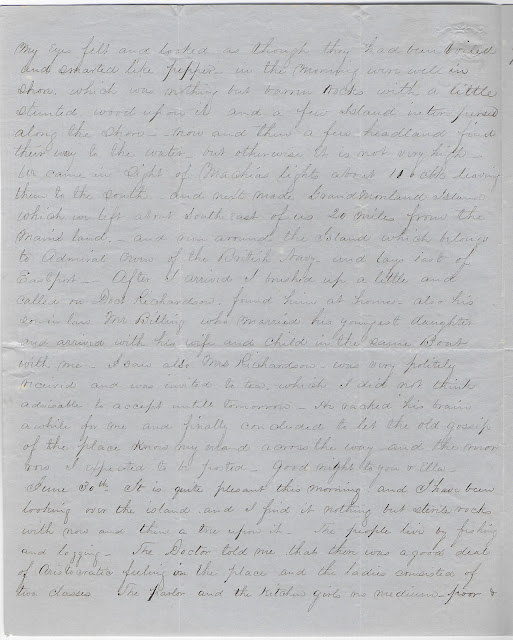
I am at last in Eastport, having arrived here this afternoon at 1/2 past one o'clock after a very plesant trip so far as weather and good sea go to make a voyage plesant. I left Boston as I expected at 11 o'clock A.M. But Cousin Mary was not there to meet me - so I am all alone once more - The voyage was quite monotonous, nothing to see but just the rocky share of Maine in the distance. We arrived in Portland at 1/4 before 8 o'clock and made a stop of 15 minutes - jumped on shore so that I might say that I had been in the place. It seems to be a thriving place the eastern part is lately built over and looks new around the Lighthouse. The Rail Road runs along between the City and the water's edge and tends to make it look more business like. The business is mostly trade with the West Indies. When we arrived Neal Dow of Maine Liquor Law notoriety was on the wharf - having his eyes on what was going on. Two miserable sots aboard when we left gave three cheers for "Dow" and the Law" out of spite - they were then so drunk that they could hardly stand much to their discredit. we left the wharf at 8 o'clock - and I turned in for the night and slept soundly until about 5 o'clock My eyes felt and looked as though they had been boiled and smarted like pepper - in the morning were well in shore, which was nothing but barren rocks with a little stunted wood upon it and a few Island interspersed along the shore. Now and then a few headland find their way to the water - but otherwise it is not very high. We came in sight of Machias light about 11 o'clock leaving them to the south and next made Grand Monland Island [Grand Manan Island] which was left about Southeast of us 20 miles from the main land and run around the Island which belongs to Admiral Owen of the British Navy - and lays east of Eastport. After I arrived I brushed up a little and called upon Doct. Richardson, found him at home - also his son in law Mr. Billing who married his youngest daughter and arrived with his wife and child in the same Boat with me. I saw also Mrs. Richardson - was very politely received and was invited to tea, which I did not think advisable to accept until tomorrow. He racked his brain for me and finally concluded to let the old gossip of the place know my errand across the way and the morrow I expected to be frosted. Good night to you & Ella.

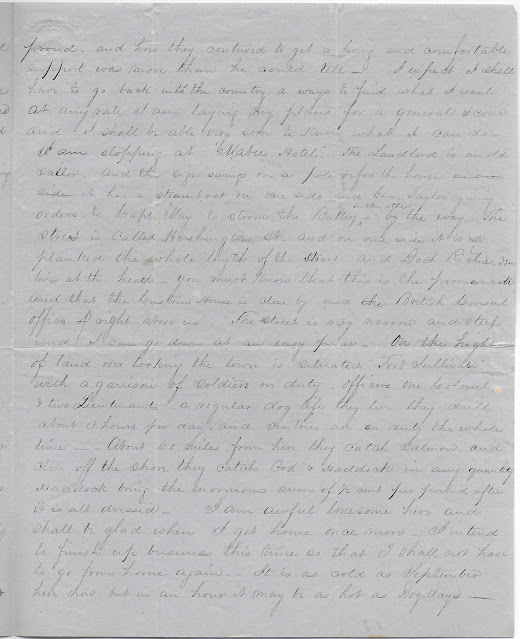
June 30th - It is quite plesant this morning and I have been looking over the island and I find it nothing but sterile rocks with now and then a tree upon it. The people live by fishing and logging. The Doctor told me that there was a good deal of Aristocratic feeling in the place and the ladies consisted of two classes. The parlor and the kitchen girls no medium - poor & proud and how they contrived to get a living and comfortable support was more than he could tell. I suppose I shall have to go back into the country a ways to find what I want. At any rate, I am laying my plans for a general scour and I shall be able very soon to know what I can do.  
I am stopping at "Mabee's Hotel". The Landlord is an old sailor. And the sign swings on a pole before the house. It has a steamboat on one side and Gen. Taylor giving orders to Capt. May to storm the Battery on the other. By the way, the Street is called Washington St. and on one side it is all planked the whole length of the street and Doct. Richardson lives at the head. You must know that this is the promenade and that the Custom House is close by and the British Consul office right above us. The street is very narrow and steep and I can go down at an easy pace. On the hight of land overlooking the town is situated "Fort Sullivan" with a garrison of soldiers on duty. Officers one Colonel and two Lieutenants a regular dog life they live. They drill about 3 hours per day and sentries are on duty the whole time. About 60 miles from here they catch salmon and close off the shore they catch Cod & Haddock in any quantity, Haddock bring the enormous sum of 1/2 cent per pound after it is all dressed. I am awful lonesome here and shall be glad when I get home once more. I intend to finish up business this time so that I shall not have to go from home again. It is as cold as September here now but in an hour it may be as hot as Dog-days. Take good care of yourself and Ella until come back and look out for mad dogs, cats & c__. As for the garden, pick and eat and spare not, on my account - but be sure and not get sick.

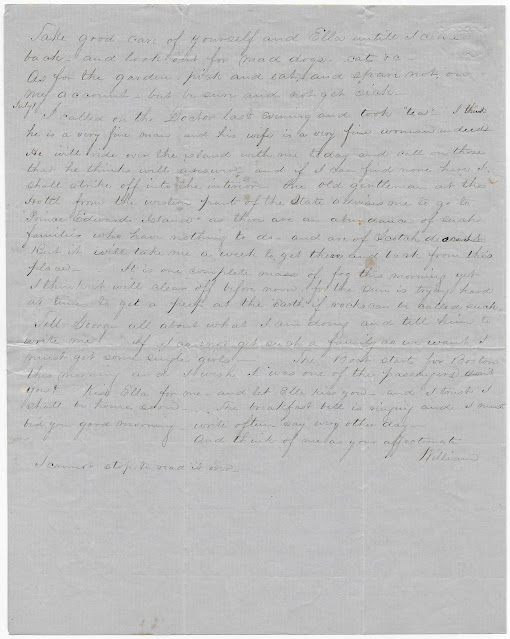
July 1 - I called on the Doctor last evening and took "tea". I think he is a very fine man and his wife is a very fine woman indeed. He will ride over the island with me today and call on those that he thinks will answer. And if I can find none here I shall strike off into the interior. One old gentleman at the Hotel from the western part of the State advises me to go to "Prince Edwards Island" as there are an abundance of such families who have nothing to do - and are of Scotch descent. But it will take me a week to get there and back from this place. It is one complete mass of fog this morning yet. I think it will clear off before noon for the sun is trying hard at times to get a peep at the "Earth" if rocks can be called such.

Tell George all about what I am doing and tell him to write me. If I cannot get such a family as we want I must get some single girls. The Boat starts for Boston this morning and I wish I was one of the passengers, don't you? Kiss Ella for me and let Ella kiss you - and I trust I shall be home soon. The breakfast bell is ringing and I must bid you good morning. Write often - say every other day - And think of me as your affectionate
William
I cannot stop to read it over -

Sadly the map below cannot give the option to travel by sea, let alone to travel by sea, then by land across the Isthmus of Chignecto and then again by sea to Prince Edward Island, but it will have to do.

Saturday, January 15, 2022

1916 Letter by Corporal A. H. Thompson, Company G, Maine National Guard, Serving in Laredo, Texas during Mexican Border Expedition - Photo of Eastport, Maine, Soldiers

Reprinted, with permission, from the Heirlooms Reunited blog

July 13, 1916 article in the Bangor Daily Commercial, Bangor, Maine, featuring a letter from Corporal A. H. Thompson, serving in Company G, Second Maine, Maine National Guard, while deployed to Laredo, Texas, during the Mexican Border, or Pancho Villa, Expedition.

The article features a photograph of 8 unidentified soldiers from Eastport, Maine.

A transcription appears at the end of this post.  The letter reflects the thinking of the day and may cause a wince here and there.
In the book by Captain Jonathan Bratten, Historian of the Maine National Guard, entitled To the Last Man: a National Guard Regiment in the Great War, 1917-1919, pages 9-15 discuss the Maine Guard's participation in the Mexican Border Expedition.

Read more about this deployment in a Bangor Daily News article of May 27, 2016. This article mentions that the entire University of Maine band signed up, and they would be the only college band in the U.S. Army - this is the band mentioned in Corporal Thompson's letter. 

The band leader was none other than Adelbert Wells Sprague (1881-1956), who arranged the music for the Maine Stein Song, which was composed in 1902 and may well have been played for the boys in Laredo.


Names mentioned, in order of appearance
  • Private Joe Pooler
  • Private O'Leary
  • Lt. Doane
  • Private Romero
  • Private Morrison
  • Private Weymouth
  • Sergeant McWilliam
  • Private Shaw
  • Private Pellum (Pelham perhaps)
  • Private Banks
  • Private Spencer
  • Private Howard
  • Private Belinian
  • Private Porer [?]
  • Carranza - Venustiano Carranza, a US-backed Mexican leader in opposition to Emiliano Zapata and Francisco Villa, "Pancho"
  • Corp. A. H. Thompson, author of the letter

If you have information on any of the men mentioned in the article, please leave a comment for the benefit of other researchers.

Transcription - note errors in typesetting, where some parts are out of sequence

BLUSTERY SAND STORM NEW SIGHT FOR MAINE BOYS

Co. G. Finds Conditions Uneasy on Border — Mexicans Are Not Trusted — Edwin O’Leary Halts Greaser While on Guard at Night


Laredo, Texas, July 6

Our train, the third section, arrived at Laredo, at 10:30 p.m., July 4, without mishap.

At once a guard, with ball ammunition, was placed around the train, which remained until 4 a.m. when the train was abandoned.

Guard duty fell upon the Co. G. boys, first relief going on at 10:30. A different feeling prevailed when the boys were called out to guard for the first time against a real enemy, and the only humorous part during the lonesome night was when Private Joe Pooler challenged a dog, thinking it a Mexican crawling on hands and knees.

The second battalion was formed shortly after 4 a.m., and marched to the camping grounds.

The camp is located on a sandy plain near the banks of the Rio Grande. 

When we arrived at the camp we found that the first two sections had already pitched their tents and were nearly settled.

We at once started on our hard day’s work in the scorching sun, which was completed before 5 o’clock at night.

A description of Laredo was given in a northern paper and the climate was stated as being mild. We found the temperature to be over 100 degrees and exceptionally dry, in fact there has not been a rain storm since November last.

During the day a severe sand storm came upon us and caused much havoc in camp. Tent tops, papers, blankets, etc., were blown into the air about 50 feet and our eyes were filled with sand. The depth of the loose sand being about six inches, everything was covered, and after the storm had passed we were pitiful looking objects.

The boys stood up well under these conditions, but did not have a very good feeling toward the mild climate of Laredo.

Orders were received at 5 p.m. that Co. G was to perform guard-duty the first night at Camp after being on guard the night before about the troop train.

It is very unusual for one company to go on guard for two nights in succession and the circumstances were extremely severe as we had traveled for six days a distance of 3560 miles.

The boys were weary but responded, and put in the first night with some interesting experiences.

Guard Mount 6.30 with Officer of Day, Sergeant, Corporal and two squads for duty.

Relief was given every 2 hours to the guard on duty.

On third relief Private O'Leary, Post, No. 2, halted two Mexicans who were entering the camp.

The sergeant and corporal of the guard were called and the Mexicans, who could not speak English, were escorted to the guardhouse.

Officer of the Day, Lieut. Doane, summoned Private Romero, who has an excellent command of the Spanish language and these suspicious looking Mexicans were questioned.

Their explanation was not altogether satisfactory, but they were allowed to be dismissed with instructions that if they appeared about the camp again severe measures would be taken.

Post No. 2 is a very undesirable location to be in during the middle of the night and it is at such an occasion that one realizes the rifle is to be his best friend.

Posts No. 2 and No. 3 guarded by Private Morrison and Private Weymouth on the second relief were approached by Mexican civilians as they call themselves, but  did not attempt to advance further.

At 9 o’clock a provost guard consisting of Sergeant McWilliam, Privates Shaw, Pellum, Banks, Spencer, Howard, Belinian, Porer and myself was called to guard the city districts against trouble and to remove side arms from any member of the 2nd Maine regiment.

There was a band concert on the Plaza park where we disarmed a number of soldiers, and sent a few back to Camp.

No Soldier is allowed down town with arms, as a few bad words might result in a real mix-up, especially if a gun was in the near vicinity.

The unarmed soldiers, however, all protected by a provost guard from each regiment and by special sentence [because of the newspaper's error, the rest of the sentence - “-can Artillery out of commission in short notice”  is found in another part of the article; see at the end].

We made report a camp about 11 p.m., turning over all alarms that we secured to the officers of the day.

The nights are very warm but nothing compared with the heat of the day.

Five shower baths have been placed at the head of each Street and are constantly in use.

The plan of the camp is in accordance with Camp Keyes, Augusta, and those who have visited us at our former camp may use their imagination to that effect.

The Second Regiment band gave a concert after mess and helped to cheer us up after the hard day's work.

This band is very popular and as they are required to practice several hours each day they will soon compare favorably with the leading military band of the country.

The second day at camp proved to bet [be] even warmer than the first and the only possible comfort was obtained at the shower baths.

Those who participated in this pleasure, however, suffered from severe sunburn.

A regular routine has not been prepared yet but we are advised that we are to have continuous drilling from 7 to 10 o’clock in the morning and other than special details the day's hard work is considered over.

We do not have much time to call our own, however, as it is necessary to clean the camp thoroughly twice a [several paragraphs erroneously inserted here - see these at the end] day, care for the rifles and side arms once a day, sprinkle the ground about our squad tents, bathe twice a day and attend mess three times a day, guard mount, inspection of arms, calisthenics and numerous other details.

During the afternoon some of the best citizens of the city appeared at the camp with four auto loads of refreshments, and passed it around among the boys. Did we cheer?

After mess the camp was visited by regulars from the different regiments. These fellows had seen service for many years and their experiences were well worth hearing. They were formerly at Sandy Hook and just after the raid on Co. M. received their orders to report at the border. The trip was made in 63 hours and as soon as they arrived they retired Carranza’s troops to a position across the river.

They said that the only fear they have of advancing into Mexico from Laredo is that water will not be reached for 70 miles after leaving the Rio Grande, and this a small stream passing through a town called Columbia.

The Mexicans are efficient in the handling of machine guns, but have made a very poor showing with the use of rifles during previous border attacks.

Should war be declared the invading forces would be led by the Texas rangers, followed by the regulars and two regiments of militia, Maine, Missouri and Texas.

The regulars advise that the different regiments were watched when they encamped and that the Second Maine proved to be the best appearing regiment to encamp and compared favorably with the regular army.

They advise that the Texas militia are drilling constantly from reveille to taps. This could not possibly be done by the other militias as they are not accustomed to the extreme temperature and sand.
The most credit is given to the Texas Rangers, who are the finest type of fighters in the country. These rangers have a thorough knowledge of the Mexican territory and are relied upon to furnish all information regarding condition of country and position of the enemy’s troops should we invade.

The Rangers are employed as state detectives at the present time and have especial privileges.

Should a Mexican civilian cause any unnecessary trouble with a Ranger he receives a charge of cold steel, nothing more being heard from the incident.

The militias is receiving real instructions in regard to position to be taken in event of trouble and formation of each individual should a night attack be made.

These instructions are not to be repeated. I have found that there is no weight in many of the statements made by the press and that most all have been exaggerated to a great extent.

Official information proves that the conditions existing between the two countries are very much unsetled [sic], and that if extreme care is not taken there will be plenty of cause for trouble.

The Mexican situation will never be settled until after military law has been established throughout that country and the different bands are scattered.

The civilians here never go about with the free and easy spirit that the people of the middle and northern states do and the soldiers out of camp have to keep their eyes open.

The Co. G boys, however, have arranged for a ball game to be played late Sunday afternoon against the regulars, providing the recreation will be allowed.

We were allowed to go down town from 7 to 10 p.m. but hardly any took advantage of this privilege, sleep appealing much more.

A shot was fired on one of the posts last night but we are not able to find out the cause or result of it.

Two trains leave for the north each day, and this letter is just in time for the last.

Be sure that you do your share toward providing the boys with mail matter.

A letter reaches the camp four days after leaving Bangor.

Corp. A. H. Thompson


Out of sequence paragraphs


While we were marching down a Mexican avenue, we were requested to jump aboard an auto, that a soldier was in trouble. When we arrived on the scene a private from the 14th cavalry was lying on the ground unconscious having been struck by a Mexican civilian. We took the soldier in the auto to a doctor and made an arrest. This was the only trouble we encountered during the night.

The Mexican element is about 50 per cent of the entire population and for this reason, special attention is given to the boys without arms who must mingle with them while out of camp.

We had an opportunity to see the town, and to watch the lights of the Mexican artillery camps across the river.

This regiment of artillery is located on a high bluff across the Rio Grande and our Regular troops who are stationed on the river bank, advise that the Mexican field pieces are trained on our camps.

It is not exactly comfortable to know that shrapnel may be thrown on us at any time from these field pieces, four miles distant, but we have consolation in knowing that 1,300 cavalry troops at Fort McIntosh, a New York Regiment of Coast Artillery, and the Ninth Infantry would place this Mexican artillery out of commission in short notice.  [part of this sentence was inserted erroneously in another section]


Thursday, January 13, 2022

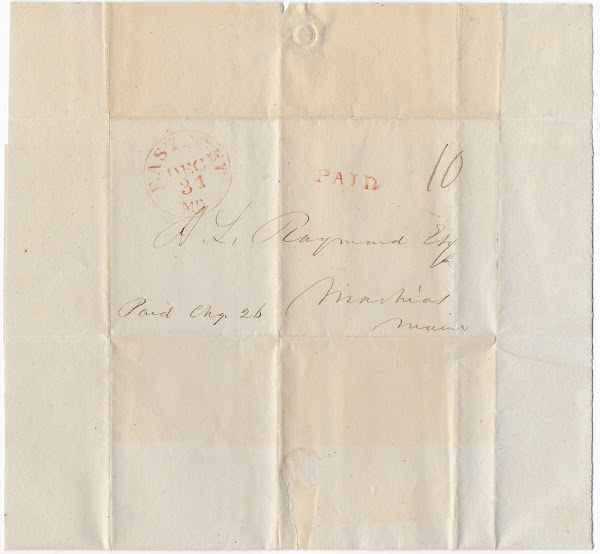
1837 [?] Letter from Daniel Tristram Granger in Eastport, Maine, to Aaron L. Raymond, Esq. in Machias, Maine

Reprinted, with permission, from the Heirlooms Reunited blog.

December 30, 1837 letter from Daniel Tristram Granger in Eastport, Maine, to Aaron L. Raymond, Esq., Clerk of Courts for Washington County, in Machias, Maine.  Court matter regarding Mason vs. Kilby.  

Although the year appears to be 1817, Granger was not born until about 1807, so 1827 or 1837 is more likely.
  • Daniel Tristram Granger (1807-1854) of Eastport, Maine
  • Aaron L. Raymond, Clerk of the Judicial Courts for Washington County, Maine
  • Capt. Leavitt, possibly Benjamin Brackett Leavitt (1798-1881), whose photograph is shown here.
  • Mason v. Kilby

If you have information on either of these two men, please leave a comment for the benefit of other researchers.

Transcription - please leave a comment if you can fill in the blanks
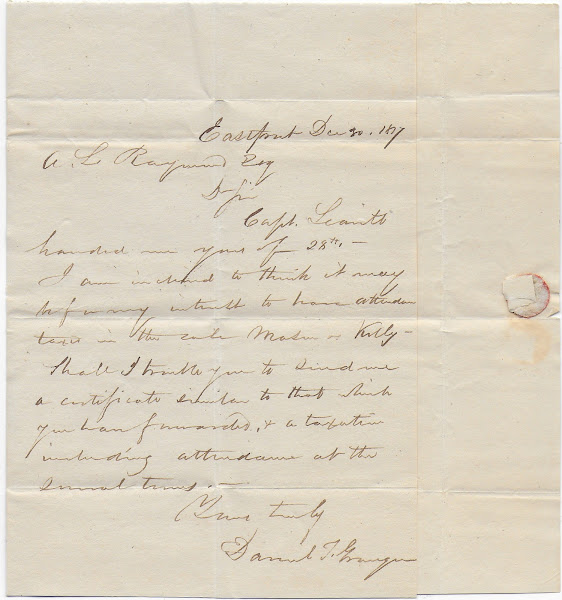
Eastport Dec 30, 18x7
A. L. Raymond Esq
Dr Sr
Capt. Leavitt handed me yours of 28th. I am inclined to think it may be for my interest to have attendance taxed in the ___[case ?] Mason vs. Kilby. 
Shall I trouble you to send me a certificate similar to that which you have furnished, & a taxation including attendance at the ___ ___. [same time ?]
Yours truly
Daniel T. Granger

Since this letter was in response to one brought from Raymond to Granger by Capt. Leavitt, the likely route was by sea, rather than the inland routes shown on the map below.

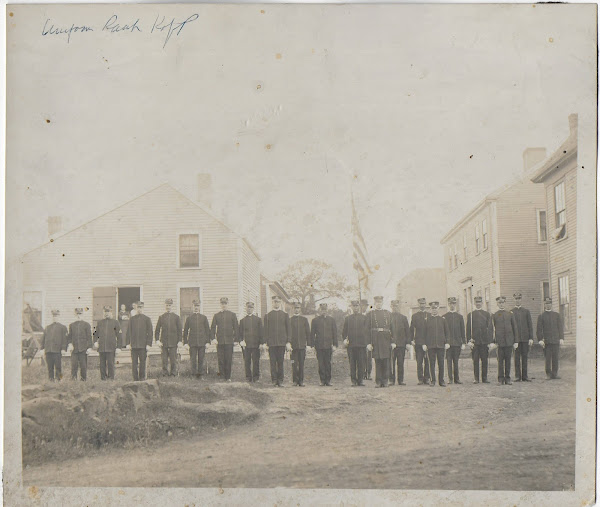
Late 19th or Early 20th Century Photograph of Knights of Pythias Members at Eastport, Maine

Reprinted, with permission, from the Heirlooms Reunited blog

Late 19th or early 20th century photograph showing members of the Knights of Pythias lined up at Eastport, Maine, with two ladies looking on from a nearby building.  Approx. 9-1/2" by 8".

Nothing on reverse.

In 1928/1929, the Eastport members made their "Hall" in a three story wood building on the corner of Water and Boynton Streets, a building that is now recognized as part of the "Eastport Historic District". 

If you can identify the photograph's setting and/or have information on late 1800s to early 1900s members of the Knights of Pythias in Eastport, Maine, please leave a comment for the benefit of fellow researchers.

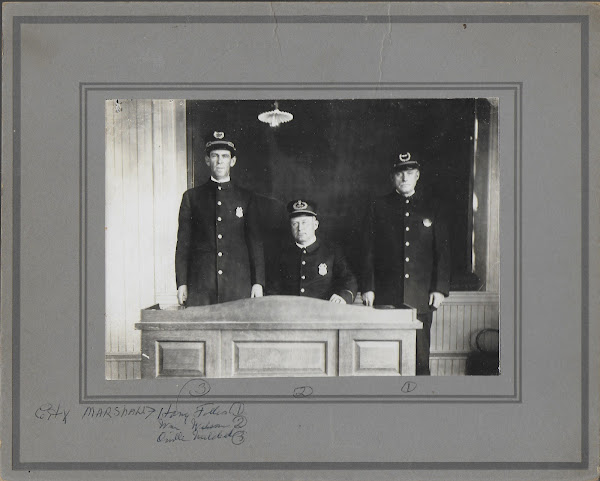
Before 1915 Photograph of three City Marshalls at Eastport, Maine: Wilson; Mitchell; Follis

Reprinted, with permission, from the Heirlooms Reunited blog.

Before 1915 photograph of three City Marshals at Eastport, Maine: Chief William Wilson, center, and Orville Mitchell and Harry Follis

The order shows Mitchell on the left and Follis on the right, but the man on the right appears to be older than the man on the left.  Assuming Follis was Harry Leo Follis (1880-1949), he was a decade younger than Orville Emereth Mitchell (1860-1921).  Hopefully a reader with family photographs will weigh in.

If you have information to share on any of these men, please leave a comment for the benefit of other researchers.

Wednesday, January 12, 2022

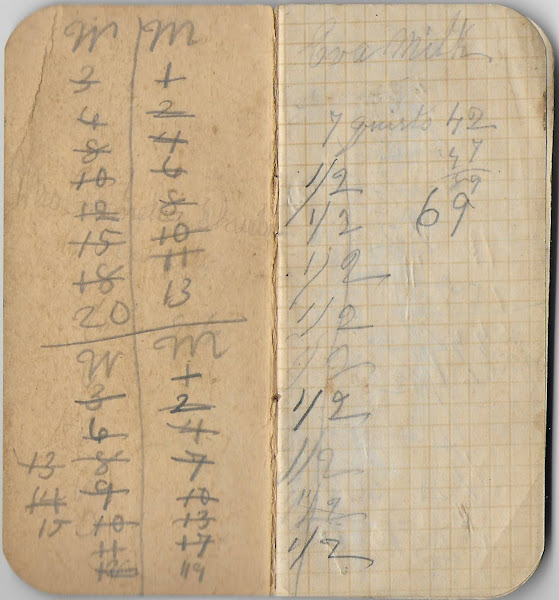
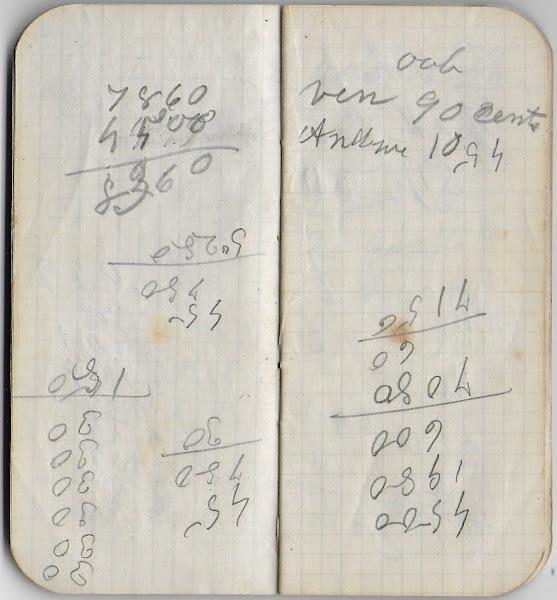
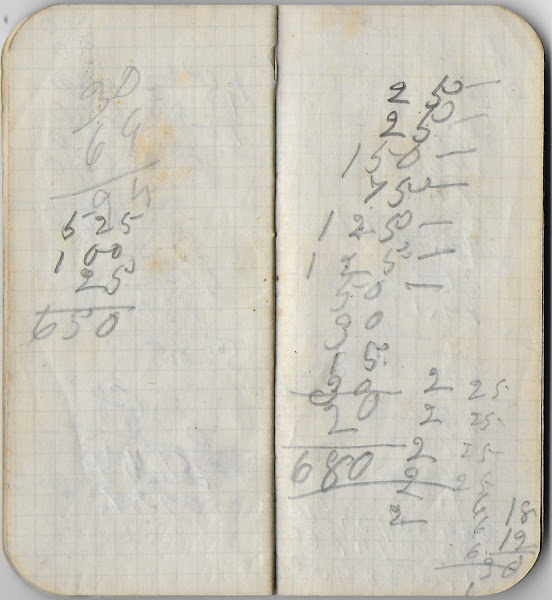
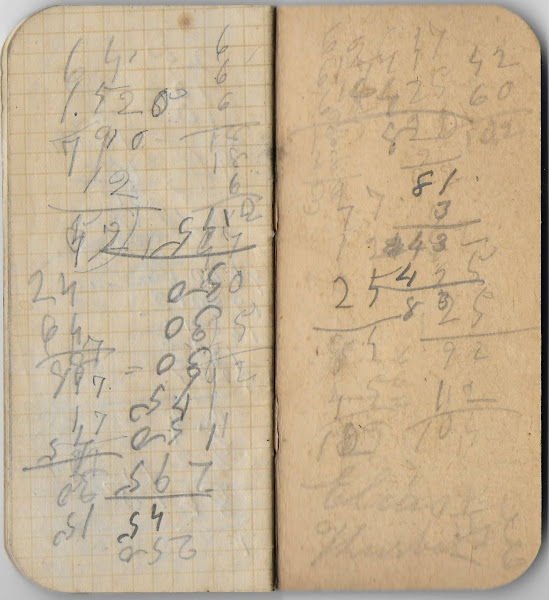
Notebook for Customers of George W. Capen of Eastport, Maine; possibly owned by Elias Thurber of Campobello Island, New Brunswick

Reprinted, with permission, from the Heirlooms Reunited blog

Small notebook given to customers of George W. Capen of 61 Water Street, Eastport, Maine.  

Possibly owned by Elias Thurber (1841-1925) of Campobello Island in New Brunswick, Canada - his name appears on the inside back cover.

Capen sold a wide variety of items, as the back cover shows - everything from Lumber to Refrigerators to Horse Harnesses to Plows to Bran and Oats.
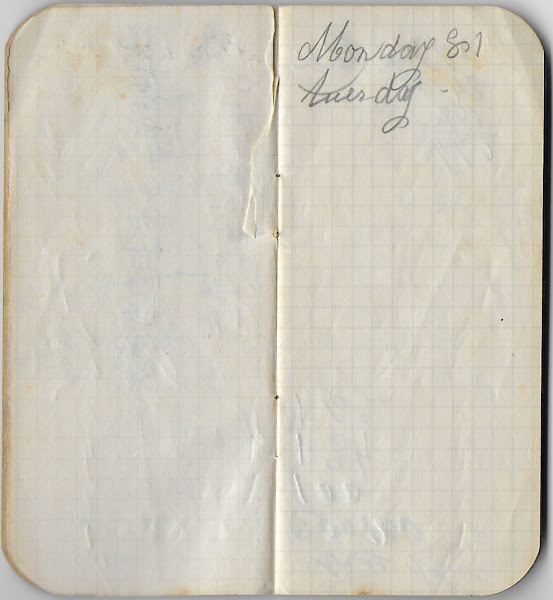
The page below shows the name Eva.

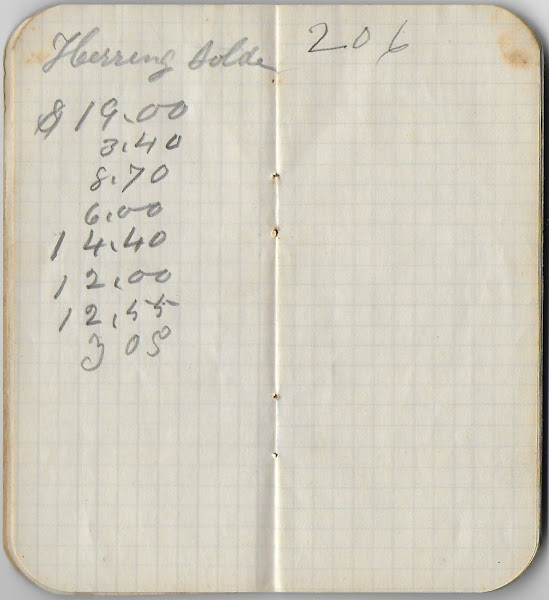
The page below shows the value of herring sold.
The page below might show the name Addie.
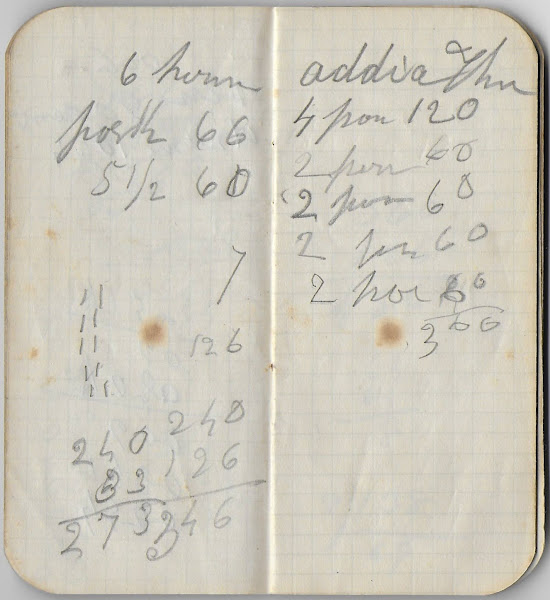
The inside cover, below, shows the name Elias ?, perhaps Elias Thurber.  Interestingly, there was an Elias Thurber (1841-1925) on Campobello Island, New Brunswick, just across Passamaquoddy Bay from Eastport, Maine.  Perhaps Elias was the owner of this little notebook.
If you have a theory as to the owner of this notebook or the names that appear in it, please leave a comment for the benefit of other researchers.